When starting your own sauce brand, many people begin by asking "Which factory can produce it?" "What's the MOQ?" or "What's the price per kilo?"
But from the perspective of building a brand for the long term, there is another matter just as important as price and minimum quantity: whether the factory you choose has an R&D team specialized in that type of product.
Because sauce contract manufacturing doesn't end with simply scaling up a recipe and packing it for sale. Turning an idea into a product that can actually be manufactured, with consistent quality, controlled costs and appeal to your customers, requires food knowledge, production experience and market understanding together.
So if you are choosing a factory to start or develop your own sauce brand, here are 5 reasons why specialized R&D is one of the factors you should use to decide on a factory.
First, What Does the R&D Team of a Food Manufacturer Do?
R&D stands for Research and Development , or the product research and development department.
In the food business, the R&D team doesn't just think about "which recipe tastes good." It has to consider a product from many angles, from taste, texture, ingredients and production process to product stability, shelf life, cost and suitability for packaging.
Especially in sauce contract manufacturing , where each type of product has very different properties.
Dipping sauces, marinades, glazes, salad dressings, mayonnaise, cheese sauces and cooking sauces each have different details in recipe development and production.
This is why having an R&D team with specialized experience helps brand owners reduce trial and error.
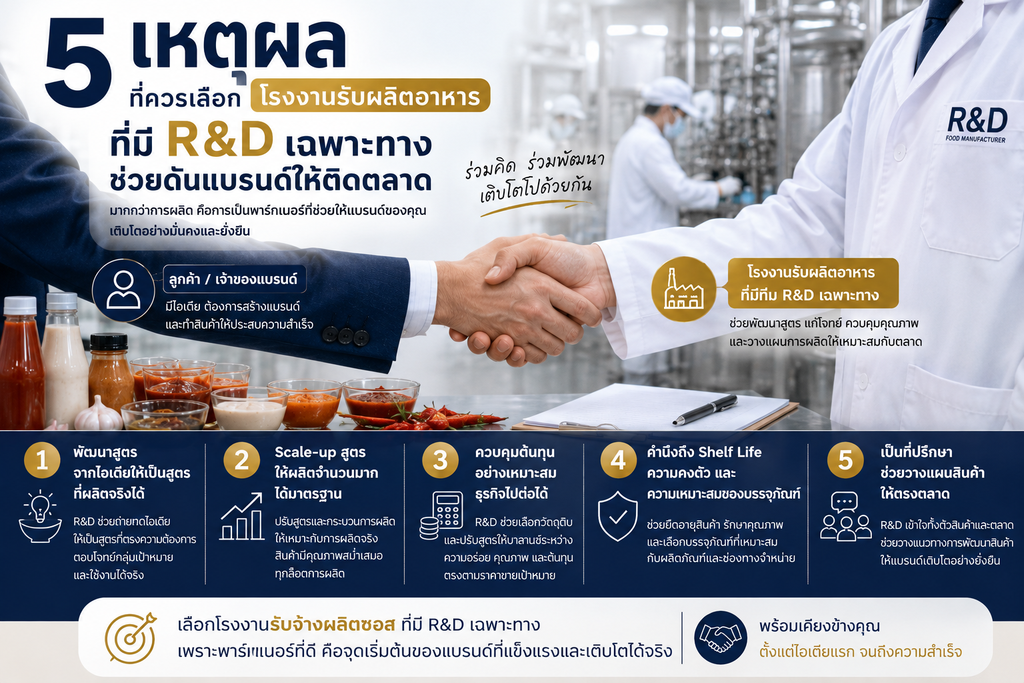
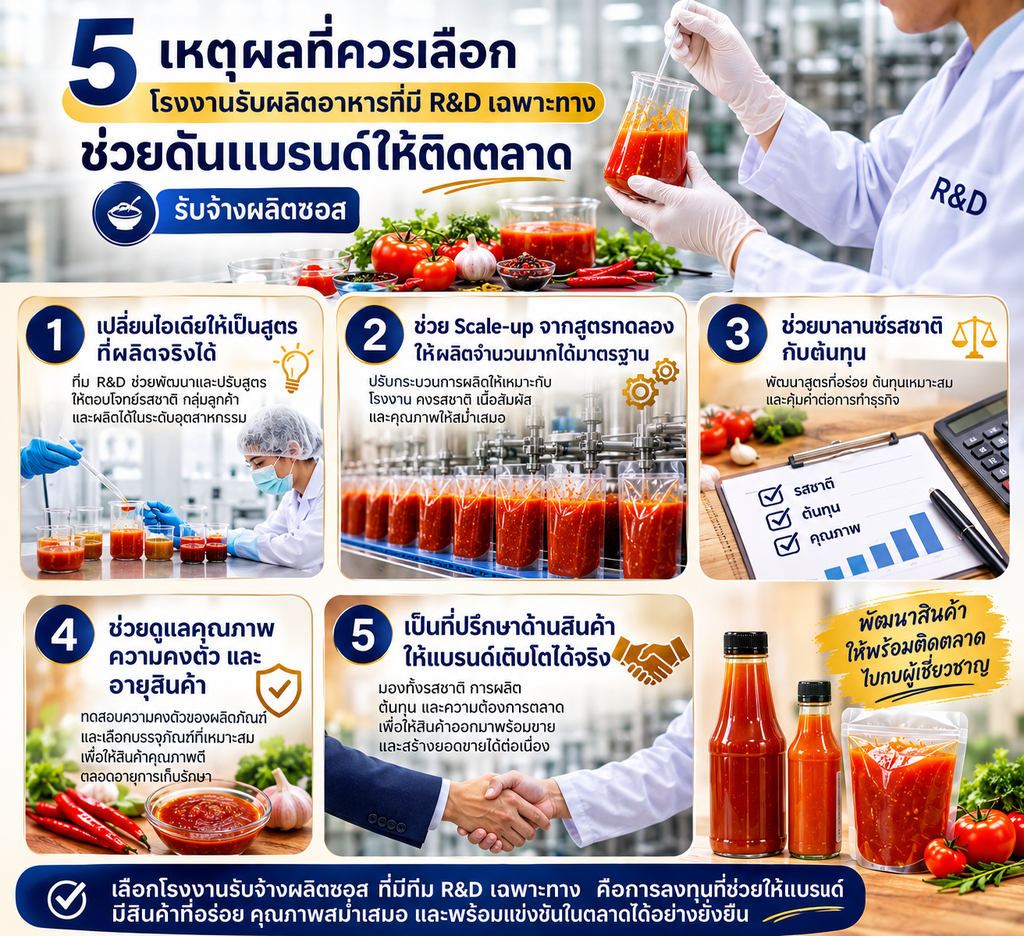
1. R&D Turns an "Idea" into a Recipe That Can Actually Be Produced
Many brand owners start with an idea, such as
"I want a sweet and spicy sauce for fried food"
"I want to sell my restaurant's signature sauce"
"I already have a recipe I make in the kitchen, but I want to produce more of it"
or even a product on the market they like, which they want to develop into a product with their own brand's character.
These are good Product Concept ideas, but they are not yet recipes ready for industrial production.
The R&D team helps turn these needs into a clearer brief, such as what kind of taste you want, who the target group is, how the product will be used, how thick it should be, and whether there are cost or ingredient constraints.
Then they develop and adjust the recipe until the product is close to the brand owner's concept and can be developed further for real production.
Consult Tip: You don't always need a finished recipe before talking to R&D, but you should have as clear a "picture of the product you want" as possible, such as your customer group, taste, use, target price and reference products, because this information helps the development team understand the brief faster.
2. Scaling Up from a Trial Recipe to Mass Production While Keeping the Standard
A common misconception is that
"If a 1 kg recipe tastes good, producing 1,000 kg just means multiplying every ingredient by 1,000."
In reality, scaling up a food product involves much more than that.
As production volume increases, equipment, mixing methods, the order of adding ingredients, time, temperature and process can all affect the final product.
A sauce tested in a small batch may have good taste and texture, but some properties may change once it goes onto a real production line.
An R&D team that works with the production department therefore plays an important role in adjusting the recipe and process for real production, so each batch is as close to the standard as possible.
For brand owners, this is very important, because customers expect that if it tasted good the first time they bought it, the next time should give them a similar experience.
Product consistency is therefore directly part of a brand's credibility.
3. Balancing "Taste" and "Cost" So the Business Can Keep Going
Of course, every brand owner wants their product to taste as good as possible.
But in business terms, the question isn't just
"Does this recipe taste good?"
You also need to ask
"If we make this recipe, can we sell it at a price the market accepts and still have a margin for the business?"
Suppose you want to sell a bottle of sauce in the mass market. If the recipe uses very expensive ingredients, even if it tastes good, once you add product cost, packaging, shipping, marketing and channel margins, the selling price may be too high to compete in your target market.
An experienced R&D team should therefore understand both Product Requirement and Cost Target.
In some cases, it may be possible to adjust proportions, choose different ingredients or modify parts of the process to get a product that keeps the desired character while having a cost that suits the business model.
This is where choosing a factory for sauce contract manufacturing shouldn't just be about "who offers the lowest price," but whether the factory can help develop a product that balances quality, cost and market price .
Consult Tip: Before you start developing a recipe, set a target price from the beginning, such as the approximate retail price, package size and sales channel, because a 59-baht product and a 159-baht product have different frameworks for recipe development and cost.
4. Considering Shelf Life, Stability and Packaging Before Real Production
A product that "tastes good on the day you test it" is not enough to put on the market.
The product must maintain suitable quality throughout its defined shelf life, which requires considering several factors depending on the type of product, such as
- color, aroma and taste
- texture
- separation
- product stability
- quality during storage
- suitability of the packaging
Packaging isn't just about looks, because each type of packaging has different properties and limitations.
Sometimes brand owners choose a bottle or bag mainly for its design, but when used with the actual product, they may need to consider whether it works with the factory's filling process and whether it suits the nature of the product.
The R&D team therefore works with the relevant departments to assess suitability before commercial production.
Thinking about these things from the start reduces the chance that the brand will have to go back and change the packaging or make major recipe changes when preparing to launch.
5. Good R&D Should Be a "Product Advisor," Not Just Someone Who Takes Your Recipe and Produces It
For SMEs or brand owners new to the food business, what is more valuable than simply finding a factory is having a partner who can ask questions you may not have thought of yet.
For example:
"Who is this product meant for?"
"What dishes will customers use the sauce with?"
"Do you want to sell in restaurants, online, retail stores or modern trade?"
"Roughly what selling price have you set?"
"How do you want to stand out from products already on the market?"
These questions may look like marketing issues, but they directly affect product development.
A sauce for restaurants and a consumer-pack sauce may have different requirements, and products sold online and products that go on retail shelves may need different thinking on size, packaging, cost and positioning.
So an experienced R&D team shouldn't only look at "what recipe the customer wants," but should also understand "how the customer will use this recipe to run their business."
When product development starts from a clear business objective, the chance of developing a product that fits the market increases.
A Tasty Recipe ≠ A Product That Always Sells
This may be one of the most important things brand owners should know before starting OEM.
"A tasty product" and "a product ready for the market" are two different things.
A product may be praised as very tasty during trials, but if the cost is too high, quality is inconsistent in mass production, the packaging isn't practical or the final price doesn't match the target group, it may be hard to market.
On the other hand, a product with a clear concept, a taste that fits the target group, an affordable price, consistent repeatable production and an easy-to-understand selling point may have a better chance of growing in the market.
So product development shouldn't start with just the question
"How do we make it as tasty as possible?"
on its own.
You may also need to ask
"How do we make this product suit customers, be producible, sell at a reasonable price and grow along with the brand?"
Before Choosing a Sauce Contract Manufacturer, Ask These 7 Questions
If you are comparing factories, don't just ask about MOQ and price per kilogram. Add these questions too:
- Does the factory have an R&D team for product development?
- If you only have a concept and no recipe yet, can they help develop one?
- If you already have a recipe, how can they help adjust it to scale up to real production?
- Can you set a target cost before starting recipe development?
- What is the process for trials and sample approval?
- Can the packaging you want be used with the product and production line?
- When you increase production volume in the future, can the factory support your brand's growth?
The answers to these questions will give you a clearer picture of whether the factory you are choosing is just a "product manufacturer" or can also be a “Development Partner” for your brand.
If I already have a recipe, do I still need R&D?
Yes,
especially for recipes made in restaurants, central kitchens or in small quantities, because bringing a recipe into factory-scale production still needs to be reviewed and adjusted to suit the actual process.
The R&D team can use your original recipe as a starting point before developing it further where needed, such as the production process, product consistency, cost and storage-related properties.
For restaurants that already have a Signature Sauce , working with a sauce contract manufacturer doesn't mean changing the whole character of the recipe, but developing its original identity so it is ready for production on a larger scale.
If I don't have a recipe at all, can I still talk to a factory?
Yes. In fact, many business owners start with a concept before they have a finished recipe.
Things to prepare before talking to the R&D team include:
- the type of sauce you want
- the taste or character you want
- your target customer group
- dishes or ways it will be used
- reference products close to what you want
- the package size you have in mind
- sales channels
- target selling price
- expected production volume
You don't need to answer every point, but the more information you have, the more clearly the product development team can see your brand's direction.
Recipe Development with Pure Foods: How Much Does It Cost and How Long Does It Take?
To help you plan your budget and timeline more clearly, here are Pure Foods' recipe development terms as confirmed by our sales team.
- Recipe development fee: THB 20,000 Includes 3–5 rounds of adjustments, credited back as product value on your first production order (first PO). Applies to all product groups.
- Each adjustment round takes about 7–14 days
- Tasting samples of 100–500 g
- We take on recipe development of all kinds
- An RD Center and a Pilot Scale line for trial production before scaling up to full production
- After the recipe is confirmed and a PO is issued, the first lot takes about 30–60 days (30 days without imported raw materials, 60 days with imported raw materials)
Recipe rights: Recipes that customers bring remain the customer's, while recipes developed by the company, including improvements the company develops on top of an existing recipe, belong to the company. These terms should be clearly discussed before development begins.
Read more: How Long Does an OEM Production Order Take · Manufacturing from Your Own Recipe: Who Owns the Recipe · OEM Manufacturing MOQ for Sauces, Dipping Sauces and Seasoning Powders
When Choosing a Sauce Contract Manufacturer, Don't Look Only at "Production Price"
For SMEs, budget is important, and comparing prices from several factories is normal.
But if the difference is small, choosing based on price per kilogram alone may not reflect the total cost of creating a product.
If you have to revise the recipe many times, change the packaging after preparing to launch, or the product doesn't match the positioning you want after it's produced, the costs lost may be greater than the difference in production price at the start.
What you should compare is the Total Value you receive, such as R&D capability, expertise in the product category, production line readiness, consulting, support for future scale and understanding of the customer's business requirements.
Summary: A Factory with Specialized R&D Helps You Start Building Your Brand with Direction
Choosing a factory for sauce contract manufacturing shouldn't end with the questions "What's the MOQ?" or "How much per kilo?"
because what brand owners are really investing in is not just "one batch of sauce" but a product that will represent the brand in the market.
An expert R&D team therefore plays an important role, from turning an idea into a recipe and developing a product that can really scale up, to managing costs, assessing packaging suitability and helping align product requirements with the target market.
For restaurant owners, SMEs or business owners with an idea for their own sauce brand, you don't need to start with a perfect recipe.
Start with a clear concept, understand who your customers are, and choose a factory ready to develop the product with you.
If you are looking for a factory for sauce contract manufacturing you can bring your concept, existing recipe, sample products you like, target group or desired price to consult the Purefoods team, to discuss product development options and assess feasibility before starting real production.
📞 Phone: 081-546-6606 (24Hrs)
LINE: Line : @purefoods
E-mail: Pure Foods
